

Quick Fact: Rooftop Solar and Our Local Energy Future
Rooftop Solar and Our Local Energy Future
Washington State is pushing hard to remove carbon emissions from our daily lives — retiring coal plants and electrifying heating and transportation, including the electric ferries. Meeting that new demand reliably and affordably is the challenge in front of every utility in the region.
Regional demand is projected to grow sharply this decade, and new large-scale renewable projects can’t be permitted and built fast enough to keep pace. Going forward, there is no “business as usual.” San Juan County will need a lot more local generation to cushion power-price spikes and to keep the lights on during the extreme-weather cold snaps and heat dome events when our members need reliable power the most.
 OPALCO renews its BPA hydropower contract in 2028. But there is no new hydro to meet the future needs of our growing island population, and our submarine cables are approaching their limits. BPA will provide our current base load (230 GWh ) with affordable Tier 1 wholesale pricing. But all new load growth will be subject to potentially very expensive Tier 2 market rates. During heat domes and cold snaps, those rates can spike 50x higher. Community electric load is projected to reach about 350 GWh by 2045. Local generation is how we close that gap on our own terms and minimize Tier 2 mainland price shocks.
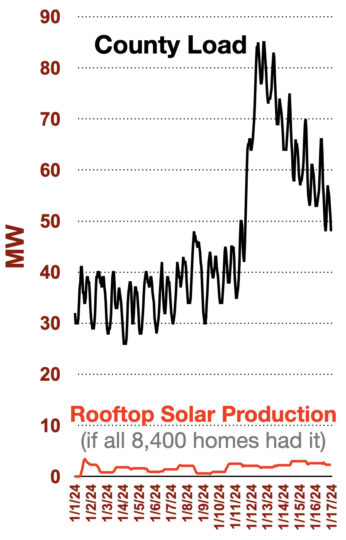
Rooftop solar is essential to our energy transition — but it can only do so much. The chart above shows the January 2024 cold snap, when regional power nearly crashed. The black line is county load; the red line is what rooftop solar would have produced if every house in the county had a system. It barely moves the needle. And rooftop solar doesn’t work during a blackout — it shuts off when the grid goes down.
How much rooftop solar is there in San Juan County?
- Thanks to co-op members and OPALCO rebate and Switch It Up (SIU) programs, OPALCO member rooftop solar provides 14x more share of load than Washington state average.
- More than 1,000 home and business solar systems are now interconnected across the islands — about 11 MW in all, up from roughly 720 in early 2024. After a major 2025 buildout — a residential rush to finish projects before the federal solar tax credit expired, with large grant-funded commercial systems following — member rooftop now supplies close to 5% of county load.
- Rooftop solar has grown steadily since 2008, but it was first driven by early adopters who could afford the systems.
- In 2022, OPALCO’s SIU program roughly doubled the growth rate by making rooftop solar affordable for the average member through low-interest, on-bill financing.
Can rooftop solar solve our future energy needs?
- There’s a common misconception that solar on every rooftop and parking lot solves the problem. It doesn’t — rooftop solar is not a “silver bullet.”
- Only a building/property owner can choose to install rooftop solar, and they size it for their own needs and property characteristics — not for county load.
- Each rooftop system has its own inverter, and at scale that can degrade grid power quality, requiring grid investment to manage. A single well-designed utility-scale array can produce as much energy as all our rooftop systems combined, through one high-quality inverter.
- OPALCO strongly encourages every member with a viable roof to install solar. But rooftop can only do so much. As the chart below shows, even as installations keep rising, member solar’s share of county load reaches a peak just above 5% in the early 2030s and then declines — because county load is growing as potential rooftop locations shrink. Covering every remaining rooftop and parking lot still tops out near that level. Meeting the rest takes utility-scale renewables.
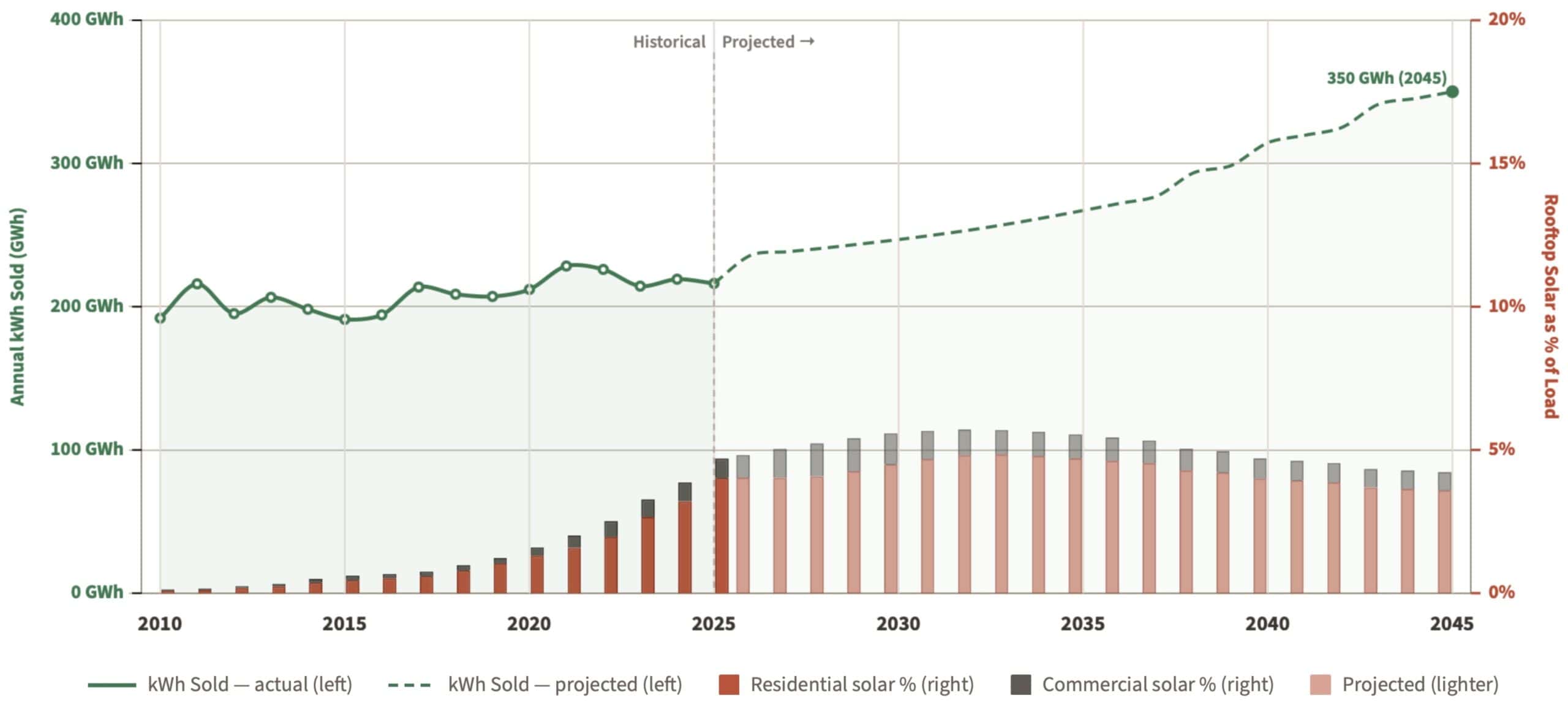
Member rooftop generation as a share of county load, historical and projected.
Even with steady growth, rooftop peaks near 5% around 2030 and slips as load climbs toward 350 GWh by 2045.
Why doesn’t OPALCO lease rooftops or parking lots?
- Any member with a rooftop or paved surface can already install solar, and OPALCO’s on-bill financing and grant programs — Switch It Up and Energize San Juans — help pay for it.
- OPALCO can’t take on responsibility for repairing and maintaining privately owned roofs.
- We have a duty to make the best use of member capital. Rooftop and parking-lot solar costs about six to ten times more per kWh than utility-scale solar.
- More liability for less benefit makes rooftop leasing too expensive and too risky for the co-op to pursue on members’ behalf.
To keep member energy costs low, protect the co-op’s return on investment, and make sure local supply can meet fast-growing demand, OPALCO is prioritizing:
- Member rooftop solar through the Switch It Up program;
- Grant-funded Utility-scale solar and storage on suitable land — especially in partnership with farmers, to strengthen both food production and farm economics;
- Land donations and renewable-energy easements that let us site projects efficiently and get the most local energy per dollar.
The Decatur Island solar project — approved by the County Hearing Examiner in May 2026 — shows this local, utility-scale model working in practice. Projects like it produce far more energy than rooftop solar can. OPALCO’s Best Fit siting work will score candidate land against clear, published criteria (Preferred, Qualified, and Restricted tiers), so projects go where they make the most sense for the land and the grid.
Agrisolar: Harvesting the sun twice
The 2022 USDA Census of Agriculture for San Juan County counts 264 farms on 19,571 acres, and most of them lose money: 71% operated at a net loss in the most recent census, and county farming as a whole lost close to a million dollars. The average working farm grosses about $40,000 a year and spends about $47,000 to earn it — a loss on the order of $7,000 per farm. And the commercial farms genuinely trying to make a living aren’t failing because they’re hobbies or tax shelters; they’re squeezed by the price of island land and a scale too small to absorb it. With farmland prices still climbing as our population grows, business as usual farming economics don’t pencil out, and to grow more of our own food we need farm economics that do.
Agrisolar helps on both fronts. Panels are raised on stilts so crops or livestock continue underneath — dual use of the sun, producing food and energy. A land lease for agrisolar can bring a farm $1,200 to $1,500 per acre per year in steady income — an agrisolar lease can cover a typical farm’s operating shortfall, while the working land stays in production.
And with accelerating climate impact, research on agrivoltaics finds that partial shade cools the ground beneath the array during the hottest part of the day and slows evaporation from the soil, so crops and pasture hold their moisture longer and can need less irrigation through a dry summer. In the Olympic rain shadow, where our summers run dry and fresh water is the scarcest thing we have, that is no small thing: the same acre yields energy, income, and a lighter draw on the well. How much shade helps depends on the crop (grazing sheep, kale, pollinators) and on how the array is spaced — the kind of detail a well-designed project works out with the farmer up front
The scale is modest: utility-scale solar and storage on less than 1% of the county’s land could supply most of the future demand not covered by BPA and rooftop solar — clean power generated here, by us.
Learn More
OPALCO Quick Facts
- Renewable Energy Siting Criteria — how OPALCO scores candidate land for local projects.
- Decatur Island Solar Expansion — a permitted local project in action.
- OPALCO’s rate for members who have rooftop solar — how net metering works here, and how we reduce cost-shifting onto non-solar members.
- Northwest Resource Adequacy in a Rapidly Decarbonizing World — background on the regional supply-demand squeeze and blackout risk.
Farm economics & agrisolar
- Jack’s Solar Garden (PBS NewsHour) — Colorado farmer Byron Kominek’s “Brief But Spectacular” take on turning hay fields into a working agrivoltaics farm.
- Low-Conflict Solar Development in Oregon — an agrivoltaics information session with OSU’s Chad Higgins, hosted by Oregon’s Department of Land Conservation and Development.
- Agrivoltaics: pairing solar with farming — the National Renewable Energy Laboratory’s research hub on the benefits, costs, and trade-offs of co-locating solar and agriculture.
- The Future of Affordable Farming in San Juan County (San Juan Islands Agricultural Guild) — the local picture behind the figures in this Quick Fact: an aging farm workforce, farmland priced as an amenity rather than a livelihood, and why a farmland-commons model could keep these acres in food.
- Harvesting the Sun (short film) — agrisolar explained by experts from Oregon State University, National Renewable Energy Labs, and others.
- Agrivoltaics Combines Production of Agriculture and Solar Power — Sierra Club overview.
Grid, cost, and reliability
- Energy System Near Miss (Feb 2024 OPALCO Board presentation) — analysis of the January 2024 cold snap and the regional supply gap.
- Cold Snap Strains Northwest Utilities as Energy Prices Surge — wholesale prices hit soft caps during the event.
- Benefits and Costs of Net Energy Metering in Washington (E3, 2023) — independent analysis of who pays for rooftop net metering.
- Cost of Distribution Upgrades to Accommodate Distributed PV (NREL) — engineering study of grid impacts on real feeders.