


Making Way for Salmon
Orcas Power & Light Cooperative relocates poles and lines to enable habitat restoration
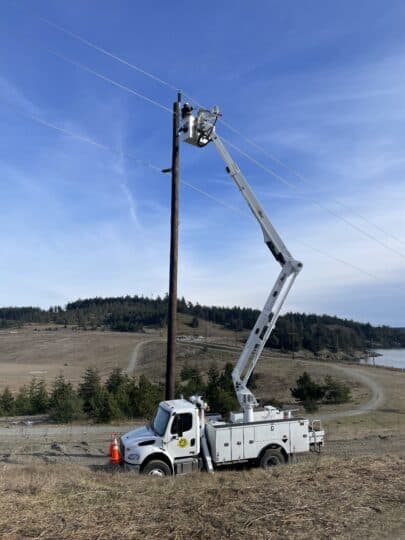
For years, two essential transmission poles serving power to Orcas Power & Light Cooperative members were on the shoreline of Jackson Beach. The poles were a necessary part of the power infrastructure serving San Juan Island.
As time passed, the bases of the poles were exposed to excessive wear and tear. Rising sea level, shoreline erosion and storm surges posed a threat to the poles’ structural integrity and longevity.
San Juan County staff approached the OPALCO team about an environmental project on Jackson Beach that would require relocating the shoreline power poles. This project, known as the Jackson Beach Salmon Restoration Project, aimed to restore the critical habitat that supports Chinook and other salmonid species populations.
Kendra Smith, San Juan County’s director of environmental stewardship, says the project will restore the shoreline and improve spawning habitat for forage fish, an essential food source for Pacific salmon, local marine wildlife and waterfowl.
This beach has the highest known abundance of these forage fish in the San Juan Islands. Unfortunately, decades of mining operations at the site disrupted their habitat and left failing rock armor in its place.
The purpose of this restoration project is to return the sandy substrate that forage fish rely on and encourage the Pacific salmon populations that desperately rely on that food source.
After careful consideration, it became clear the responsible solution was to remove the poles from the beach. This would protect and restore a critical wildlife habitat, and relocate essential power infrastructure to a more sustainable and secure location. The OPALCO team took action to make it happen.
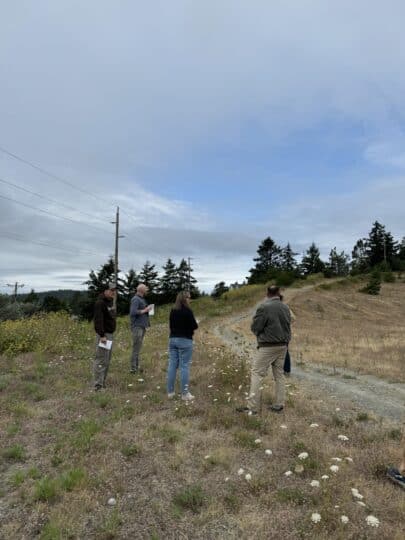
To remove the poles from the beach, the entire layout of poles in the Pear Point/Gravel Pit area needed to change. Beginning in April 2020, the OPALCO team began by proposing and mocking up multiple possible configurations. These layouts were used to propose different solutions that would get the poles off the shoreline, while also causing the least amount of disruption to the surrounding property owners and project partners.
The chosen design went through multiple revisions based on feedback from neighbors and project partners. “Island Rec played a pivotal role in getting this project across the finish line,” Engineering and Operations Manager Russell Guerry says. “Their professional approach and thoughtful partnership made all the difference.”
Once the final plans were in place, the crew began to set a timeline of work and determine next steps.
On March 26, 2025, OPALCO crews initiated an overnight outage on San Juan Island that gave them a window to set the new power poles into place, deenergize and disconnect from the old poles and energize the new poles. This outage went through most of the night, and power was restored to members by early the next morning. The old power poles were removed later to accommodate eagle nesting season. By July 2025, all of the old and out of-use power poles were gone, and the shoreline was fully freed up for the county to begin its work.
OPALCO System Designer Dan Vekved took the lead on this project. “We were in constant contact with the county on the project status for the last few years,” he says. “The hard work from those at the county and our OPALCO crews made this project really successful. The crews did a great job with the work, and these new poles are built to last.”
In addition to hardening and securing the OPALCO power infrastructure and making room for the county’s salmon restoration project, moving the poles off the beach provides additional benefits to the community. “This project offers continued recreational opportunities for kayak launching and the county’s existing barge landing operations that bring bulk supplies like gravel for local roads,” Kendra says.
OPALCO is proud of the finalized project, and staff are grateful to have worked in collaboration with San Juan County, Island Rec and other community partners and businesses involved.