


Quick Fact: OPALCO Solar Rate for residential members
OPALCO’s solar rate is designed to encourage local renewable generation while also collecting revenue to cover the cost of service. Solar producers use the grid to buy and sell power. The OPALCO system acts like a storage battery for surplus energy produced by members. OPALCO is in a course correction period to shift all rates to cover the cost of delivering power to 20 islands and, specifically for solar producers, collect the value of using the co-op grid to buy and sell power on their own systems. The following explains the details about this rate and the figures included are based on 2023 rates.
- About 4% of OPALCO members (more than 500) generate their own power – mostly via solar panels on their roof.
- These members have a specially programmed meter that tracks the power to and from the grid – this meter records the usage and excess production as it is happening.
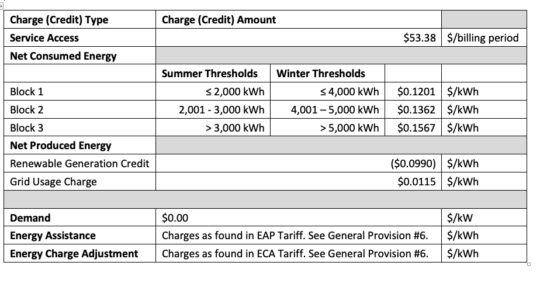
- The residential renewable tariff includes a renewable energy credit -$0.0990, a grid usage charge $0.0115, both applied per kWh. In addition to the usual charges, including service access charge, energy charge adjustment and energy assistance charge.
- Throughout the month the member generator is producing power that they either use immediately or put back on the grid.
- These members power their usage from either their own solar system or, when the sun isn’t shining, from the OPALCO grid. When members use their solar power at the time it is produced – it is not run through the OPALCO meter and doesn’t show up on the bill.
- Anytime a member’s production exceeds their consumption, that excess power, is put back on the grid. At the time power is put back on the grid, OPALCO buys that power at $0.0875. The OPALCO meter tracks that amount throughout the month, and this will show up as a credit on the member’s bill.
- When a member uses power from the OPALCO grid, they are charged $0.1201 at the time that the power is used. This shows up as a charge on the member’s bill.
- Each bill, the member will likely see credits for production and charges for usage regardless of the season (this all varies widely depending on size of solar array and energy usage in the household). In the summer, the excess production could exceed the usage, but the member could still have charges for energy usage (likely happening at night). In the winter, the member could still see production credits even if they have a lot more usage for those colder, darker months.
- This tariff – just like all tariffs – is reviewed each year and adjusted by the OPALCO Board of Directors.
2023 rate for the Tarif RDR – Residential Distributed Energy Resource Service also referred to as solar rate:
For further review on this topic:
November 2021 OPALCO Board Materials: Solar Rates Review
The photovoltaic revolution is on: How it will change the electricity system in a lasting way