


Our History
Energizing Island Life Since 1937
Islanders with Grit Built the Co-op
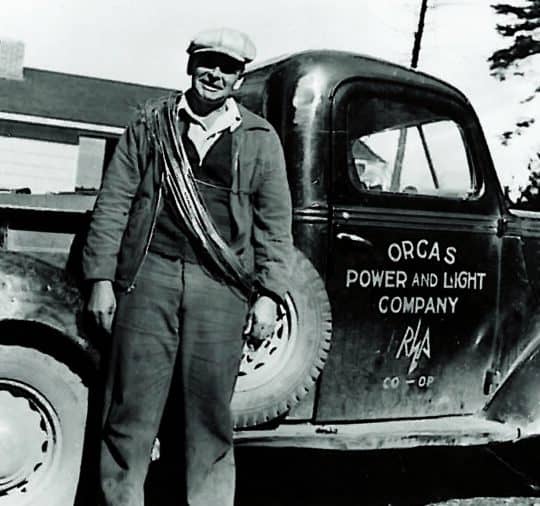
Before OPALCO was founded in 1937, islanders made do with generators, Delco battery plants and very few modern conveniences. A group of 12 Orcas men heard about the Rural Electrification Administration (REA) and went farm to farm, door to door to try and convince their neighbors that bringing electricity to the island would make their lives better. The Co-op was started with a loan from the REA and the cost to join was set at five dollars. A membership still costs five dollars today, and the Co-op now provides power to 20 islands with a reliability rate of greater than 99%. The Co-op is still owned and operated by the islanders who depend on it to power their lives.
May 11, 1935
President Franklin D. Roosevelt created Rural Electrification Administration
March 18, 1937
OPALCO founded on Orcas Island
July 1, 1938
Diesel power plant completed on Orcas Island for a total of $150,000. Power was turned off at 10pm each night until 1940 when an expansion was completed.
April 1, 1941
OPALCO purchased: Friday Harbor Light & Power and the Riviere property on Lopez Island, for a diesel plant
July 18, 1951
OPALCO connected to mainland power as BPA submarine cables energized. Shaw Island system energized.
September 1, 1961
Four submarine cables installed in Lopez to San Juan crossing
September 1, 1980
OPALCO survived the WPPSS debacle
September 1, 1987
OPALCO workers unionized through the IBEW
September 1, 1990
Island #20 energized: Armitage Island
March 21, 1991
OPALCO storm abatement program began to underground system after back-to-back 100-year storms devastate islands
September 1, 1982
First two electric vehicle (EV) added to OPALCO fleet: GM G-van and Solectria Force. First EV chargers installed. Green Power program began.
September 1, 2001
OPALCO installed fiber optic network for internal communications; Island Network established
September 1, 2003
OPALCO's Island Network opened fiber network to provide internet services to public agencies
September 1, 2011
OPALCO began electrifying its fleet with a Nissan Leaf and updated EV chargers in San Juan County
November 5, 2013
Century Link cable failed leaving San Juan County without internet, phone or 911 service
February 1, 2014
OPALCO purchased Rock Island to provide broadband to San Juan County
May 19, 2022
Rock Island Communications, a wholly owned subsidiary, provides internet services to 50% of San Juan County