

Homegrown Broadband: The Local Solution
Over the past decade, San Juan County has gone from having some of the most limited and unreliable internet service in Washington State to building a locally owned communications network that continues to expand today.
That didn’t happen because a private company stepped in. It happened because this community chose to build it ourselves.
Where We Started
In 2012, internet access across San Juan County ranged from extremely poor to nonexistent. Cellular service was equally unreliable. The primary provider at the time had made little effort to maintain or upgrade its aging infrastructure, while their customers suffered long outages and dismal connection speed – averaging just 2.5Mbps.
November 2013 brought a clear call to action, as a damaged Century Link cable took down communications infrastructure countywide; home phone, DSL internet service, even 911 connectivity went down. OPALCO was able to provide a temporary solution with their existing fiber network, allowing data to reach the mainland until the damaged line was repaired.
This incident not only illuminated the dire need for improved infrastructure, it became clear that we couldn’t rely on the “big guys” to do it for us – we needed a local solution.
OPALCO explored every option, including outreach to national telecom and cellular companies. But with a small, dispersed population of roughly 16,000 households and the high cost of building infrastructure across islands, there was no interest from for-profit providers. The economics simply didn’t work.
At the same time, reliable communication was becoming essential; for emergency services, healthcare, education, and local businesses. So the question became: If not them, then who?
A Community-Driven Solution
Encouraged by members, the OPALCO Board made the decision to step in and help bring reliable internet and communication services to San Juan County.
This was not a decision to “get into telecom.” It was a decision to solve a critical community problem.
Building the Foundation
OPALCO pursued multiple strategies to make broadband possible.
In 2013, OPALCO secured access to licensed 700 MHz spectrum through an agreement with OPALCO member Paul Allen’s company, Vulcan. This spectrum – ideal for long-distance wireless coverage – enabled a lower-cost path to begin delivering service.
In 2014, T-Mobile acquired the remaining regional spectrum, leading to a unique partnership between OPALCO and T-Mobile.
The Nation’s First Fixed Wireless
The T-Mobile relationship was structured as a no-cost exchange:
- OPALCO provided fiber distribution and mainland backhaul
- T-Mobile provided cellular equipment and operations
- Both parties shared the benefits of the network
The result:
- T-Mobile achieved near-complete cellular coverage across the islands
- OPALCO secured exclusive rights to provide fixed wireless broadband to homes and businesses
The goal was to launch service quickly, expand coverage, and begin generating revenue well before fiber could be built everywhere. The county was truly experiencing an internet crisis, and this collaboration laid the groundwork to solve it quickly.
Launching Rock Island Communications
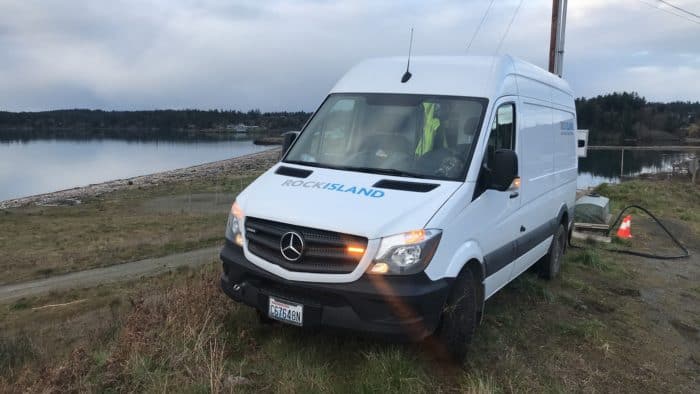
In 2015, OPALCO acquired the local ISP, Rock Island Communications, creating a platform to deliver retail internet services with local support.
Members directly supported this effort with a one-time contribution of approximately $75 per member, helping fund early startup operations until outside financing was secured in 2016.
Rock Island was structured as a for-profit subsidiary, but operates differently than a typical private company.
A Different Kind of Business
Rock Island is:
- 100% owned by OPALCO
- OPALCO is owned by its members
That means Rock Island is not driven by outside shareholders or profit maximization.
Instead, it is designed to:
- Cover its costs
- Pay back the loans required to build the network
- Reinvest in expanding and improving service
Why Subscription Rates Matter
Building and maintaining a communications network across 20 islands is expensive. The infrastructure includes fiber, wireless sites, data centers, and ongoing operations. Expanding fiber to areas without ferry service such as Center, Decatur, Blakely, and Henry islands means maintaining vessels to reach these locations for installations and maintenance.
Today, subscription revenue is used to:
- Pay off debt
- Operate and maintain systems
- Expand service to unserved and underserved areas
- Upgrade capacity and improve reliability
Rock Island is not generating excess profit, but it must remain financially sustainable.
If rates were reduced below what is needed:
- Debt obligations could not be met
- Expansion to new areas would slow or stop
- System reliability and future upgrades would be at risk
Simply put, rates are set to sustain the system – not to maximize profit. And we need your financial support to maintain our great services.
What Makes This Different
Most communities rely on outside providers whose decisions are driven by profit and scale.
San Juan County chose a different path:
- Local ownership
- Local control
- Long-term investment in essential infrastructure
A Community Asset
With local ownership comes shared responsibility. Rock Island is not “someone else’s company.” It is a community-built, member-owned system designed to serve this region for the long term. Every new connection, every upgrade, and every expansion is part of that shared investment.
Looking Ahead
In 2026, we’re over a decade into our network expansion, but the work is not finished.
Rock Island serves nearly half of San Juan County residents, but there are still members to connect, infrastructure to expand, and systems to improve. That requires steady, responsible financial management.
The same cooperative principles that brought electricity to these islands – local ownership, shared investment, and long-term commitment – are now bringing true broadband service to the community.
We’re grateful for our neighbors’ support , collaboration, and trust. It’s been an exciting and productive decade and we look forward to many more years of serving San Juan County.
Check out more here: https://www.rockisland.com/blog