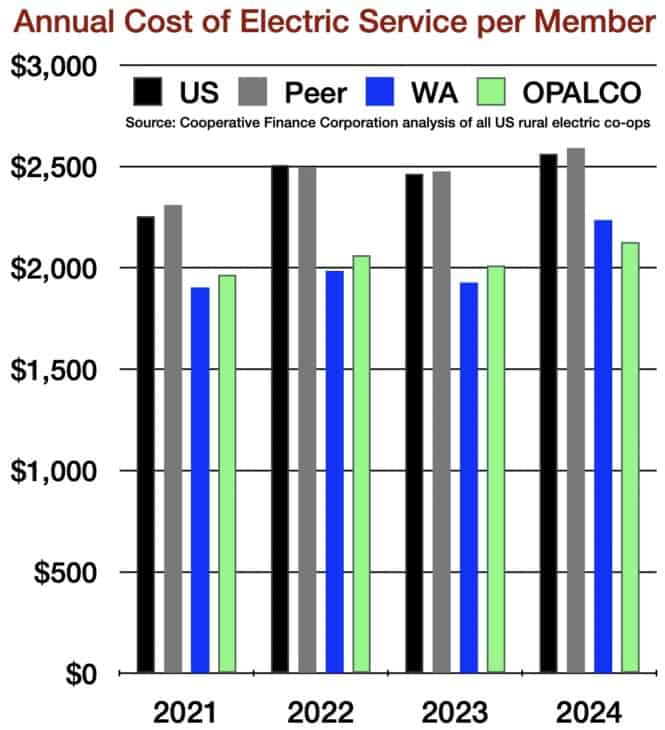


Dato breve: OPALCO vs. una empresa de servicios públicos de electricidad típica del continente
Retail Rates:
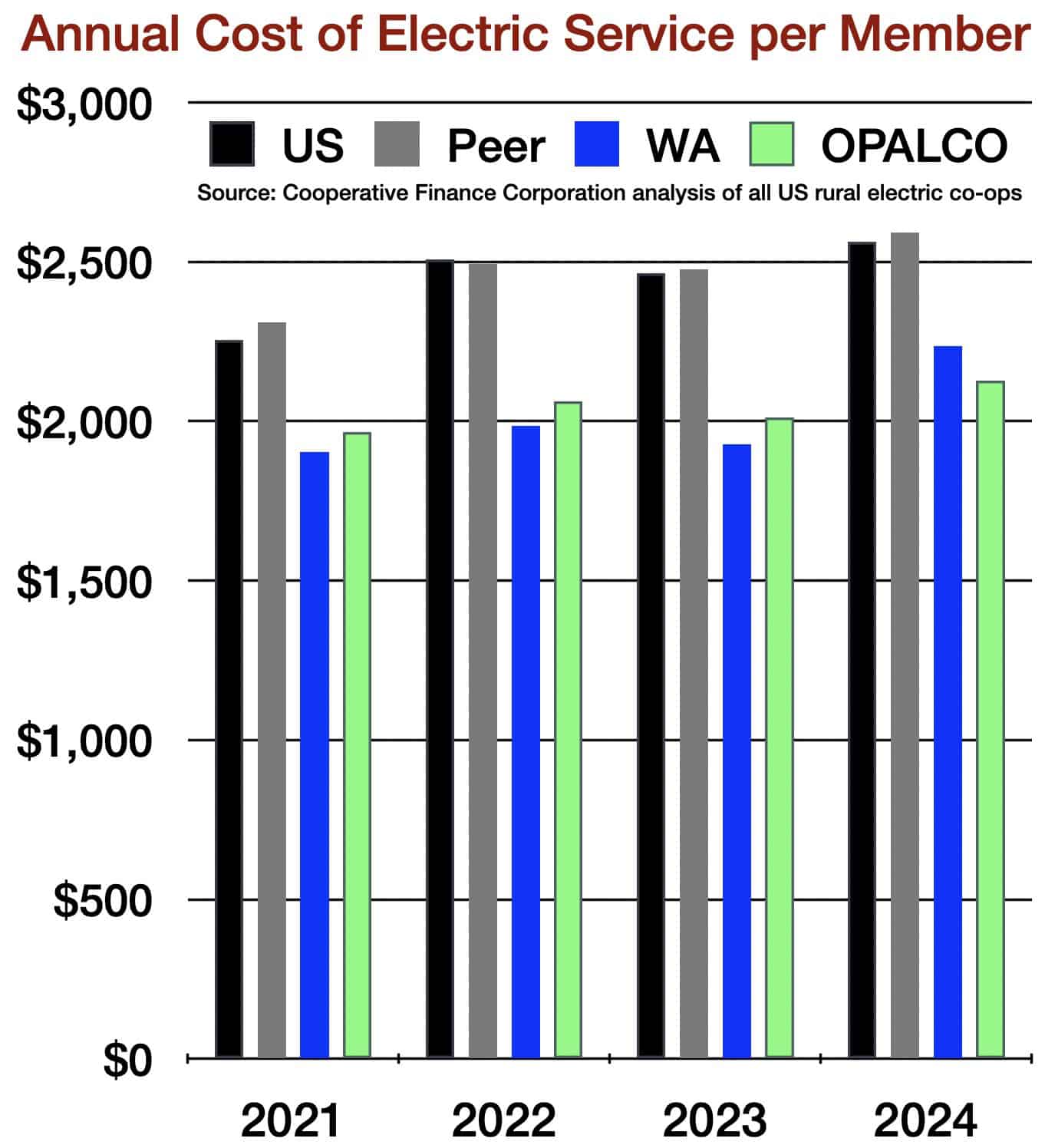
Even though OPALCO’s Retail Rates are either equivalent to or less than US and WA averages, OPALCO manages our complex grid successfully and is able to keep our rates as low as we can.
 Typical Mainland Utility
- Rates vary widely based on scale, density, and access to infrastructure
OPALCO
- OPALCO’s retail rates are comparable to—or lower than—Washington State and U.S. averages
- OPALCO manages an exceptionally complex island-based grid while keeping rates as affordable as possible for members
Service Territory
Typical Mainland Utility
- Serves a single, contiguous service area
- Nearly all facilities are accessible by road
OPALCO
- Serves 20 non-contiguous islands across the San Juan archipelago
- Construction, maintenance, and emergency repairs require marine access, ferries, boats, barges, and weather windows
- Island geography significantly increases cost, logistics, and restoration time
Customers per Mile of Power Line
Typical U.S. Utility
- Approximately 30–50 customers per mile of distribution line
- Often much higher in urban or suburban areas
OPALCO
- Approximately 10 customers per mile of distribution line (12,800 members / 1,273 miles)
- Lower customer density means higher per-customer cost to build, operate, and maintain infrastructure
Submarine vs. Land-Based Infrastructure
Typical Mainland Utility
- No submarine power cables
- Infrastructure almost entirely accessible by truck
OPALCO
- 25 submarine cable systems
- 1,095 underwater line segments
- Infrastructure exposed to saltwater corrosion, tides, seabed movement, marine traffic, and vessel strikes
- Submarine systems significantly increase capital cost, inspection needs, and outage risk
Line Crews & Reliability Staffing
Typical Mainland Utility
- Crews centralized across a contiguous territory
- Staff can be rapidly redeployed by road
OPALCO
- Requires more linemen per customer to:
- Staff multiple islands
- Meet safety and regulatory requirements
- Maintain acceptable outage response times
- Staffing decisions prioritize safety and reliability, not scale efficiencies
Substations per Customer
Typical Mainland Utility
- Often 1 substation per 5,000–20,000 customers
OPALCO
- 12 substations serving ~12,800 members
- Roughly 1 substation per 1,000 members
- Island separation prevents consolidation common on the mainland
Redundancy Requirements
Typical Mainland Utility
- Redundancy achieved through meshed, land-based networks
OPALCO
- Redundancy must be built across water
- Requires additional submarine cables and alternate pathways to:
- Reduce single-point failures
- Protect against cable damage and vessel strikes
- Redundancy is essential to island reliability but adds significant cost
Economies of Scale
Typical Investor-Owned Utility
- Hundreds of thousands to millions of meters
- Billions of kilowatt-hours sold annually
OPALCO
- Approximately 16,000 meters
- Approximately 40 million kWh in annual sales
- Fixed costs are spread across far fewer members
Electric, Internet, Cellular & Emergency Communications
Typical Mainland Utility
- Electric utility role limited to power delivery
- Broadband and cellular service provided by multiple private companies
- Emergency communications rely on dense, land-based infrastructure
- Power, communications, and public safety systems are largely independent
OPALCO
- Electric, broadband, cellular, and emergency communications are interdependent
- Through its wholly owned subsidiary, Rock Island Communications, OPALCO provides:
- Fiber-to-the-home broadband Internet
- Middle-mile and backhaul infrastructure supporting cellular service
- Connectivity for public safety agencies and critical facilities
- Communications infrastructure faces the same marine, weather, and access challenges as electric infrastructure
- Power restoration directly affects Internet, cellular, and emergency response capability
Why This Matters
OPALCO’s rates reflect the real cost of delivering reliable utility services in an island environment, including:
- Non-contiguous island geography
- Marine-based electric and communications infrastructure
- Lower customer density
- Higher per-customer staffing needs
- Responsibility for both power and mission-critical communications
OPALCO provides safe, reliable, and resilient electric, Internet, cellular-support, and emergency communications services—while keeping rates as affordable as possible for island communities.
*AI-assisted content.